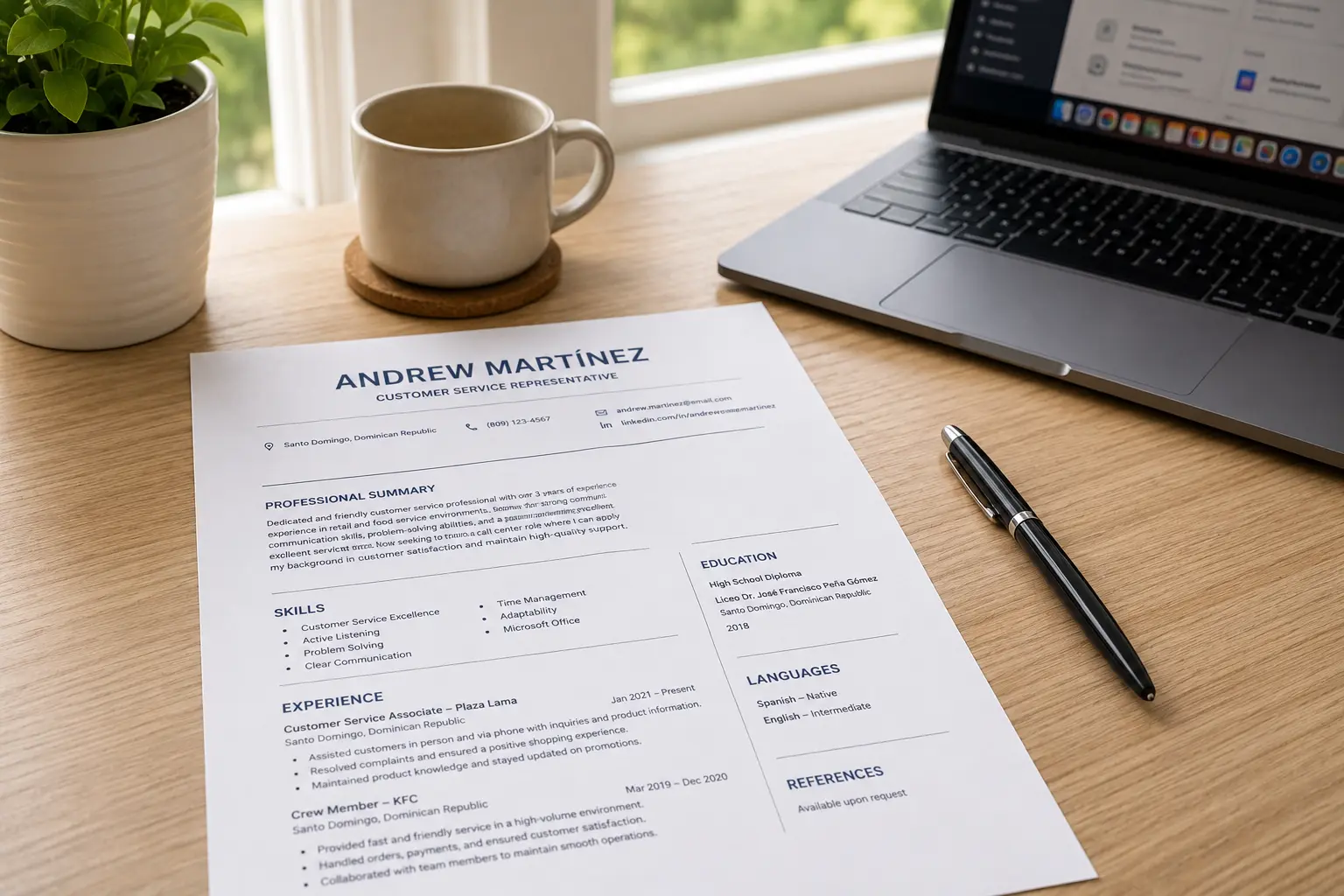
You can still walk into some call centers and ask to speak to someone in HR. That still happens. But even when it does, the person at the front desk will hand you a tablet, point you to a link, or tell you to send your resume to complete your application. The walk-in got you in the door. The resume decides if you stay.
So if your resume isn't ready, the walk-in doesn't matter.
A resume is a summary of your professional and work history. It tells a recruiter what you've done, what you know, and whether you're worth a phone call. Call center recruiters receive dozens of resumes every week. They don't read them. They scan them. And in the first few seconds, they decide if yours goes in the yes pile or the no pile.
Here's what goes in, what stays out, and what you're probably doing wrong.
Your name
Put it at the top. Make it visible. Write it in capital letters. This document exists to sell you, and nothing on it is more important than your name. Don't bury it. Don't write it in lowercase. Don't misspell it. It's your name.
Your contact information
The recruiter will skip right past this section on the first read. But the moment your resume lands in the yes pile, they're coming back to this section fast. Make sure your phone number is correct. Make sure your email works. One wrong digit and the job goes to the next person on the list.
Your work experience
This is the reason the resume exists. Every recruiter scrolls straight to this section. Write what you did, what you handled, what you were responsible for. Write in the present tense, even if the job is in the past, because you're describing skills you still have. Be specific. "Handled inbound customer calls" tells a recruiter more than "worked in customer service."
Keep it to three experiences maximum. Include the start year and end year for each one. Exact dates are harder to remember and harder to verify. Years are enough.
And here's something most candidates don't think about: if you left a job under bad terms but learned a lot there, don't list it. Take the skills and knowledge from that experience and fold them into a profile section at the top of your resume instead. In the resume world, we practice something called don't ask, don't tell. The recruiter only knows what you put there. Make sure everything on that document is helping you, not hurting you.
Your education and training
If you have a lot of courses and certifications, list the most relevant ones, especially anything connected to the position you're applying for. If you don't have work experience yet, this section carries more weight. Include everything: courses, workshops, seminars, online certifications, webinars, conferences. All of it counts.
Work from home tools
After the pandemic, call centers started hiring remote agents, and many still do. If you have a stable internet connection, a decent computer, and a quiet space at home, say so. Create a small section called Work From Home Tools and list what you have. It opens a conversation and tells the recruiter you're ready for a remote position if that's what they're offering, or what you're looking for.
What to leave out
Your photo. Your resume doesn't need a photo. Call centers hire based on whether you can speak English and handle a computer, not on how you look. Some companies will ask for one separately because they keep a photo on file for their internal systems, and that's fine. Have a professional photo with a clean background saved somewhere easy to access. But don't put it in the resume. Leave it out and don't think twice about it.
Fancy templates. Nobody cares about your layout. A beautifully designed resume with columns, colors, icons, and custom fonts often makes the content impossible to read, and some applicant tracking systems can't even read it correctly. A clean Word document written with purpose is worth ten times more than a downloaded template. Keep it simple.
Your full address. The recruiter doesn't need your street, building number, and apartment. They need to know what area of the city you're in. Write your neighborhood or municipality. Santo Domingo Este, Villa Mella, Santiago Centro. That's enough. Your full address is personal data, and your resume travels to people you don't know.
Your ID number and date of birth. Replace these with your nationality and your age. The reason they ask for your ID is to confirm you're Dominican. Just say you're Dominican. Your age tells them what they need. Save the actual ID number for when they call you and the process is already moving forward.
A messy LinkedIn URL. If you have a LinkedIn profile and want to include it, customize the URL first. LinkedIn gives everyone a default link full of random letters and numbers. Nobody is typing that. Go into your settings, customize your public URL to something clean like linkedin.com/in/yourname, and then include it. If you haven't done that yet, leave it out entirely. A bad URL is worse than no URL.
Personal references. Don't list them unless the application asks. And if you do include them, call those people first. Ask for their permission. Tell them they might receive a call about you. If someone calls your reference out of nowhere asking about you, even a good friend can fumble the answer. References belong later in the process, when you already know you're close. Don't put them on the resume to fill space.
One more thing
Some call centers will ask for more than a traditional resume. They may ask for a video resume or an audio resume. If you don't know what those are, we cover both in separate posts. For now, focus on getting your traditional resume right. That's the foundation everything else is built on.