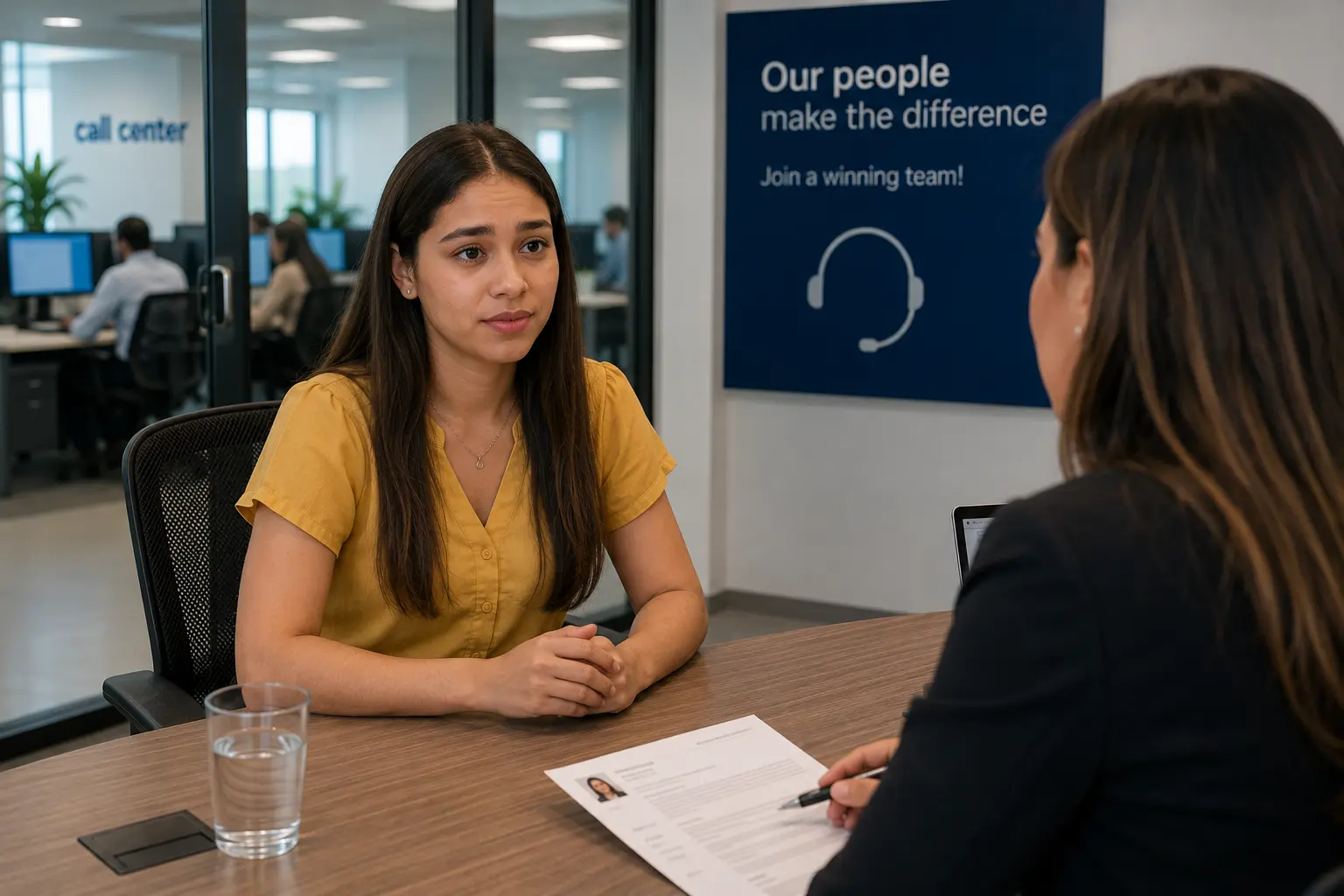
You've been to at least one. Maybe two. Maybe more than you want to admit.
You prepared. You practiced. You showed up. And somehow it still didn't work out.
And the story you told yourself on the way home was the same one you always tell: my English isn't good enough.
I'm going to stop you right there. Because I've been in that room. On both sides of the table. And I can tell you with complete certainty that English is rarely why people fail a call center interview.
Here's what's actually happening.
The filler problem
Hmmmm. Ammm. Emmm. Eeehhhh.
You know exactly what I'm talking about.
The interviewer asks you something. You know the answer, or at least you know enough to respond. But instead of responding, you buy time. You fill the silence with sounds that aren't words, and you keep going, and the interviewer is sitting there watching you drown in your own hesitation.
The problem with fillers isn't just that they sound bad. It's what they communicate. They tell the interviewer one of two things: you're so nervous you've lost control of the conversation, or you don't have the words to respond. Either way, it's not a good sign for someone who's about to spend eight hours a day talking to customers.
The moment they freeze
Here is something that happens in almost every interview and nobody ever prepares candidates for it.
The recruiter asks a question. And they speak fast. Maybe faster than you expected. And your brain does not catch every word. And right there, in that split second, a choice happens.
The candidate who is not prepared thinks: if I ask them to repeat the question, they are going to think my English is bad. So instead of asking, they try to answer something. Anything. They piece together what they think they heard and start talking, and now they are answering the wrong question, or giving a response that makes no sense, and the recruiter is looking at them confused, and the whole thing falls apart.
Here is what that candidate did not know. Asking someone to repeat a question is not a sign of bad English. It is a sign of professionalism. It happens in every language, in every country, in every job interview on earth. There are phrases built exactly for that moment.
I'm sorry, could you repeat that? I want to make sure I understand the question.
Could you say that again, please?
I want to give you a good answer. Could you repeat the question one more time?
Those are not signs of weakness. Those are signs of someone who is in control of the conversation. Someone who cares enough to answer correctly rather than just answer fast. That is exactly the kind of person a call center wants on the phone with a customer.
But if you have never practiced those phrases, they are not going to come to you in the middle of a real interview. Your brain is going to go blank and your mouth is going to say hmmmm and the recruiter is going to watch you give in to the pressure before you even get a chance to show what you can do.
That is the real problem. Not your English. Your preparation.
They quit before they get rejected
This is the part nobody talks about. Most candidates do not fail the interview. They quit it. From the inside. While still sitting in the chair.
The recruiter asks something difficult. The candidate freezes. And instead of using the tools they should have, instead of asking for a repeat, instead of taking a breath and giving a short clear answer, they shut down. They give shorter and shorter responses. They stop making eye contact. They start wrapping it up in their head before the interviewer has said a single word about the result.
They walk out and say: I failed because of my English. But what actually happened is they ran out of tools and did not know how to keep going.
The fix is not more English. The fix is more practice in the actual situations you are going to face. Practicing what to say when you do not understand. Practicing how to recover when your mind goes blank. Practicing how to stay in that chair and keep the conversation going even when it gets uncomfortable.
That is a skill. And like every skill, it gets better with practice.
The waiting room trap
You're sitting in the waiting area. There are other candidates around you. You look at them, you listen to them talk, and your brain immediately starts ranking everyone.
Then Mikika goes in before you. And in your head, Mikika has great English. Mikika is the one to beat.
Mikika comes back out. Rejected.
And just like that, before your name is even called, you've already decided you don't have a chance.
Here's what you missed: you have no idea why Mikika got rejected. You don't know what happened in that room. You took one data point you don't even understand and used it to predict your own failure.
That's not strategy. That's self-sabotage.
And I know this because it happened to me. Long before I ever thought about working in the call center industry, I sat in waiting rooms just like that one. People around me with better skills, better preparation, better everything. They went in before me and didn't make it. And I went in after them, with my dos pesos de inglés, looked the interviewer in the eye, smiled when I needed to, and got the job.
Not because I was better. Because I didn't let what happened to them happen to me.
The comparison trap
Some of you have been comparing yourselves to everyone for months. To people you see on Instagram who sound fluent. To former classmates who got hired. To some imaginary version of a perfect candidate that doesn't exist in any call center on this planet.
And every comparison ends the same way: they're better, you're not ready, maybe next time.
You have no idea what actually gets people hired. So the comparison is useless. It tells you nothing. It costs you everything.
Waiting to be ready
I've met candidates who have been almost ready for six months. They're working on their English. They're going to apply when they feel more confident.
Ready doesn't exist.
It has never existed. Not for anyone, in any industry, at any level. Nobody who has ever accomplished anything waited until they felt ready. They started, they were terrible, they learned, they got better, they figured it out along the way.
Waiting to be ready is just fear with a more acceptable name.
The interview you keep postponing is the one that teaches you what you actually need to work on. You can't get that information from practicing alone in your room.