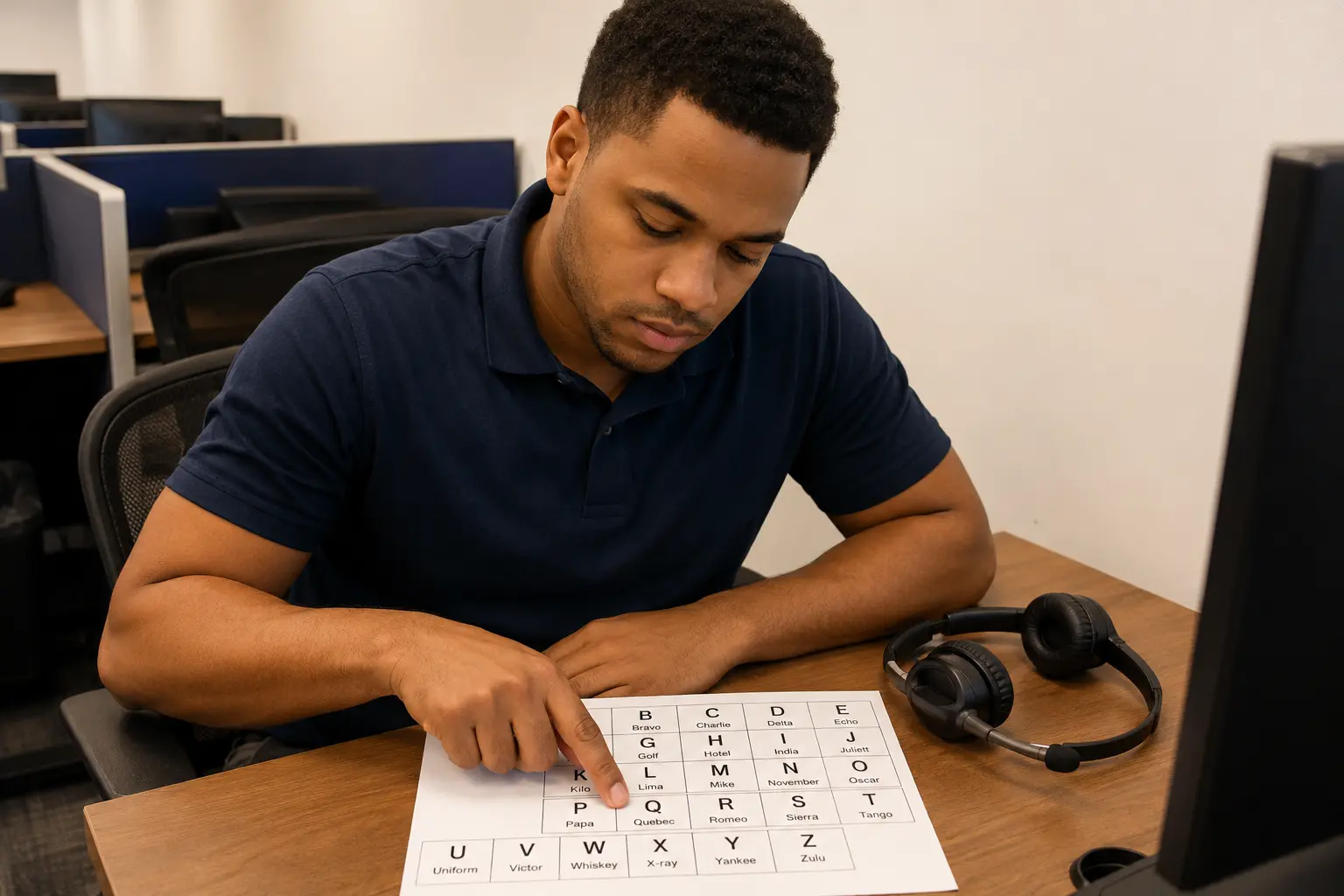
This post is for the agent who just got hired. The one who passed the interview, survived the training, and is now sitting at a desk with a headset on, a script in front of them, and a customer on the line who just asked them to spell something.
It's also for the candidate who is getting ready. The one practicing answers, studying vocabulary, preparing for that interview. The one who thinks the hard part is getting in.
Getting in is one thing. Staying calm on a live call when your brain goes blank is another. And nobody prepares you for that moment until it's already happening.
This post is about one tool that takes twenty minutes to learn and saves you every single time that moment arrives. It's called the military alphabet. And if you don't know it yet, you need to learn it before your first call.
You're on a call. The customer needs to confirm their email address. You start spelling it out and you get to the letter S and your mind goes completely blank. You say "S as... S as... stupid." The customer pauses. You cringe. The call moves on, but you don't forget that moment.
It happens to everyone. And there's a fix that takes about twenty minutes to learn and lasts a lifetime.
It's called the military alphabet, and it's not just for the army. It's used by pilots, dispatchers, call center agents, and anyone who needs to spell something clearly over a phone line without sounding like they're making it up as they go.
Why it exists
Letters sound alike. B and D. M and N. S and F. Over a phone line, with background noise and accents and a customer who's already frustrated, one misheard letter means a wrong address, a wrong account, a wrong order. The military alphabet solves that by giving every letter a distinct, widely recognized word. No confusion. No awkward pauses. No "S as sandwich."
The alphabet
| Letter | Word |
|---|---|
| A | Alpha |
| B | Bravo |
| C | Charlie |
| D | Delta |
| E | Echo |
| F | Foxtrot |
| G | Golf |
| H | Hotel |
| I | India |
| J | Juliet |
| K | Kilo |
| L | Lima |
| M | Mike |
| N | November |
| O | Oscar |
| P | Papa |
| Q | Quebec |
| R | Romeo |
| S | Sierra |
| T | Tango |
| U | Uniform |
| V | Victor |
| W | Whiskey |
| X | X-ray |
| Y | Yankee |
| Z | Zulu |
What happens when you don't know it
I taught this in my classes for years. Every single time, there were students who pushed back. They told me they didn't need it. That call centers don't actually use it. That it was extra information they would never use on the floor.
Then they got on the floor.
And the call came. The customer needed to spell something. The pressure hit. And the brain, which is already managing the accent, the script, the customer's tone, the system on the screen, just stopped producing words. So the mouth said the first thing it found. Something embarrassing. Something that made the customer repeat themselves three times. Something that made the agent want to disappear.
And then they came back and said: you were right.
I am not telling you this to say I told you so. I am telling you this because the call itself is already pressure enough. Your brain is already doing ten things at once. The military alphabet takes one of those things completely off the table. You don't have to think. The word comes automatically. And you sound like you've been doing this for years.
How to actually learn it
Don't try to memorize the whole thing in one sitting. Pick five letters you always get stuck on and learn those first. Then add five more. Within a week it's automatic.
The trick is to practice out loud. Spell your own name. Spell your street. Spell random words you see on packaging. The more you say the words, the faster they come to you when you need them on a live call.
The goal is not to recite the alphabet. The goal is for Sierra to come out of your mouth before your brain even finishes forming the thought. That only happens with repetition.
What it sounds like when you use it right
"That's S as in Sierra, T as in Tango, R as in Romeo, O as in Oscar, N as in November, G as in Golf."
That is the difference between someone who learned this and someone who didn't.
The bonus
Every word in that list is real English vocabulary. Foxtrot. Sierra. Tango. Quebec. Yankee. You're not just learning a spelling tool. You're adding words to your vocabulary that you can actually use. That's the CCA way: one lesson, multiple wins.
Next time someone asks you to confirm an email address, you spell it like a professional. No hesitation. No made-up words. No cringing afterward.
Sierra. Always Sierra.